

TYPO3 v14: the backend I always wanted
First impression
TYPO3 v14 has been out since November 2025 – and honestly, it blew me away. The backend looks like a different system. Cleaner, lighter, more modern. After years of the familiar Verdana layout and boxy module containers, the new interface finally feels like something you'd expect in 2025.
I've been working with v14.0 and v14.1 extensively and can't wait for the LTS on April 21st. Here's what won me over – and a few honest points that still have room to improve.
What actually changed
Modules got renamed – finally logical
This is the change you notice immediately. The old module names were developer-facing and internal – new users had no way of knowing what they meant. In v14, TYPO3 finally speaks a clearer language:
| Before (v13) | After (v14) |
|---|---|
| Web | Content |
| Web > Page | Content > Layout |
| File | Media |
| Admin | Administration |
That sounds like a small thing – but it isn't. Editors seeing TYPO3 for the first time now instinctively know where to look. That has real implications for onboarding and training.
New design system
b13 rebuilt the visual foundation of the backend from scratch. The key changes at a glance:
- Font switched from Verdana to Open Sans – more modern, easier to read
- Rounded corners everywhere – icons, buttons, cards: everything feels softer and more consistent
- New colour palette and lighter icons without unnecessary border boxes
- More whitespace and a clearer visual hierarchy
Redesigned DocHeader
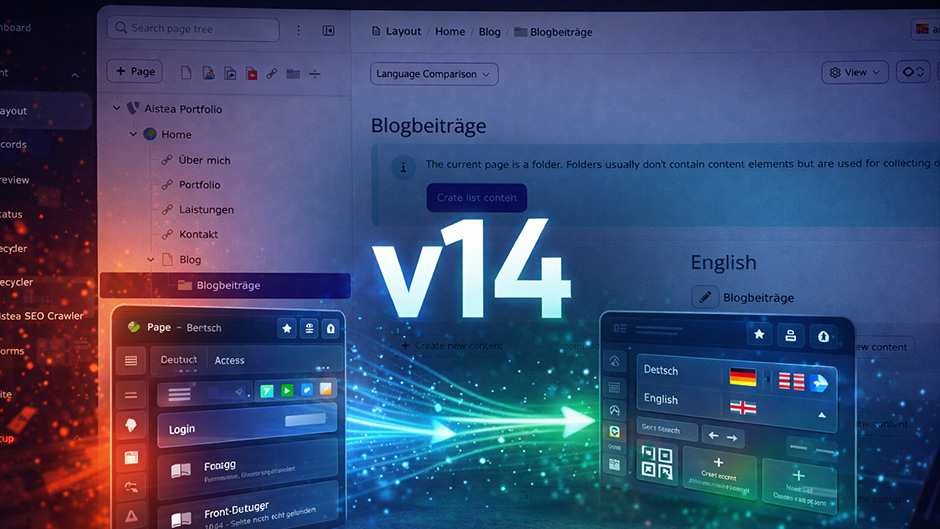
The DocHeader has been completely overhauled. It now features interactive breadcrumb navigation and a standardised language selector across all modules. The second row is reserved for action buttons (Save, Close, Reload, Bookmark) – more consistent than before, where the layout varied from module to module.
Modernised translation workflow
Long overdue. v14 introduces a step-by-step guided wizard for translations that automatically skips unnecessary steps. The language selector now allows selecting multiple languages at once – and the selection persists between the Page and List modules.
Under the hood, the localisation architecture was migrated to the Symfony Translation Component. TYPO3 now supports XLIFF 1.2 and XLIFF 2.x.
Fluid 5
Fluid was updated to version 5. Existing templates change very little – but there are some practical improvements: template files no longer need to start with a capital letter, and the new .fluid.html extension is better recognised by IDEs.
v14.1: default theme and QR codes
v14.1 (January 2026) shipped a ready-to-use default theme – fully self-contained, no third-party extensions needed. A real time-saver for new projects. Also new: a backend module for generating QR codes that link to TYPO3 pages and can be reassigned later – handy for printed materials.
What won me over
Honestly, I didn't expect the new backend to convince me this quickly. But after a few hours of working in it, it was clear: this just feels right. The design system is applied consistently throughout – you can tell there's real UX thinking behind it, not just a CSS facelift. And the module renaming might sound minor, but it makes a genuine difference day to day: editors seeing TYPO3 for the first time now immediately know where to look.
What's still missing or rough
- Extension compatibility: only 16 extensions were compatible at the v14.0 release. Things have improved since, but anyone with many custom or community extensions should check before upgrading to production.
- Visual gaps: some module areas still don't look fully consistent. The LTS release on April 21st is supposed to clean this up.
- Frontend CSS processing: comments and whitespace are no longer stripped automatically – anyone who relied on that needs to adjust their build process.
My verdict
TYPO3 v14 is the best TYPO3 yet – at least from a backend perspective. The interface finally looks as modern as the CMS behind it has always been. The module renaming was long overdue, the new DocHeader makes a difference every single day, the modernised translation workflow saves real time, and Fluid 5 lays a clean foundation for the years ahead.
For new projects, I'd wait for v14 LTS (April 21, 2026) – it's worth it. For existing v13 projects: v13 is supported until October 2027, so no rush. But a migration plan is worth starting now.
I'm genuinely excited for the LTS. TYPO3 has taken a big step forward – and I'm curious what v14.3 still has in store.
TL;DR
- Modules logically renamed: Web → Content, File → Media
- New design system: Open Sans, rounded corners, clearer hierarchy
- DocHeader rebuilt with breadcrumb navigation and standardised language selector
- Translation workflow modernised, Symfony Translation Component, XLIFF 2.x
- Fluid 5 as the foundation for the next years
- Check extension compatibility before upgrading – v14 LTS arrives April 21, 2026
Share
Leave a comment